.jpg)
Maine TREE Presents at the New England Society of American Foresters’ Winter Meeting
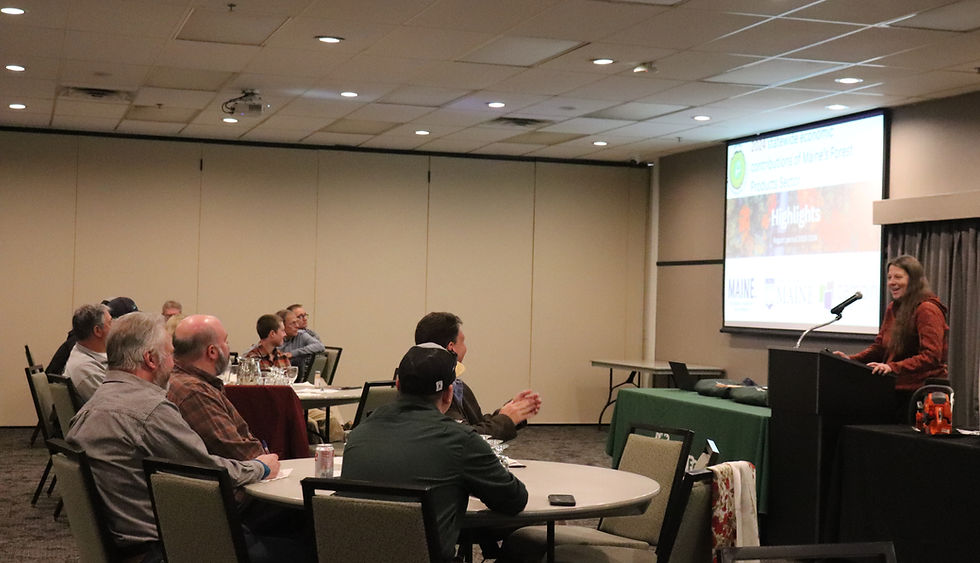
“Forest Reciprocity: What Can You Do for Your Forest and What Can Your Forest Do for You?” was the theme of this year’s New England Society of American Foresters’ Winter Meeting. With half of our staff presenting at this regional conference, Maine TREE clearly had plenty of ideas to share.
The event opened with a Plenary from Maine State Forester and Maine Forest Service Director, Patty Cormier. She led with some commonly known facts about Maine:
Maine is 92% privately-owned
Maine is 88% forested
55% of Maine’s forestland is third-party certified (the highest in the nation)
Our major forest types are Maple/Beech/Birch and Spruce/Fir forests
We produce 90% of North America’s blueberries
And Maine is the origin of the donut hole
With everyone grounded in why Maine is special and craving a donut hole, Director Cormier went into some emerging concerns for our region. She discussed how forest pests and diseases are spreading at an alarming rate, and how wildfire risk is increasing, as the average number of wildfires a year jumped from roughly 500 to almost 800. To add to our concerns, she provided a quick policy snapshot, highlighting their impacts on our forests. Generally speaking, there are significant changes, and there’s even more uncertainty about what the future holds, making the theme of this conference particularly relevant to every attendee: “What can we do for our forests?”
The Keynote Speaker, Steve Tatko, Vice President of Land and Conservation at Appalachian Mountain Club (AMC), picked up here. “...for reciprocity to work, you have to look at yourself first… and see what you can bring to these conversations.” He went on to describe how, as forest professionals, we need to communicate our value. Steve highlighted the disconnect between our forest communities and the public's perceptions of them. He compared adjectives pulled from news articles describing Maine’s forests and the communities that depend on them:
Forests
Resilient
Connected
Unbroken
Beautiful
Forest-Based Communities
Rural
Depressed
Remote
Impoverished
“We need to be able to describe the land and the people with the same adjectives...” Steve shared.
It is important to note that Steve is a history major, so we ended up down a rabbit hole about the Magna Carta and the World Wars' impact on industry, but he brought it all together to explain that Maine’s forests and forest industry can change the material culture. Our competition is synthetic materials, but “we offer solutions that are valuable, sustainable, and [people-centered].”
So we know what our forests can do for us. “What can we do for our forests?”
We can educate and train current and future forest professionals, which is exactly what organizations across New England are doing, including Maine TREE!
Maine TREE staff helped coordinate a Student Mentorship session during the NESAF Winter Meeting. Many of the students were presenting research posters and wanted to learn how to talk to the professionals at the conference, get advice on finding a job, and receive feedback on their research. The mentors, in turn, heard from the students about the experiences these future professionals want to have and the challenges they face.

Moderated by Joe Short from the Northern Forest Center, Maine TREE’s executive director, Logan Johnson, joined by Christine McGowan of the Vermont Sustainable Jobs Fund, Jasen Stock of New Hampshire Timberland Owners Association, participated in a panel highlighting workforce development initiatives in our region. The conversation focused on programs operating in each state to help prepare people for careers in the forest, the potential benefits of cross-state collaborations, and the value of place-specific programs. The group also recognized the challenges that these programs face, including funding. Questions from the audience sparked discussion about ways to connect students with career opportunities in the industry.
We can better understand how our decisions impact the future of our forests, which is exactly what many of the researchers and academics attending NESAF do, including Maine TREE!

Molly Taylor, a Ph.D. candidate at Tufts University and Maine TREE Lead Research Technician, presented a flash talk, an 8-minute presentation on a topic, during NESAF’s Winter Meeting. Her research assesses the long-term effectiveness of variable-retention forestry to maintain forest structure over time. This work contributes to our understanding of the long-term progression of forest habitat in small retention patches and provides actionable information to land managers in the Northeast to promote biodiversity and forest resilience on commercial timberlands.
We can inform and encourage current and future forest owners in the stewardship of their piece of Maine’s forests, which is exactly what organizations across New England are doing, including Maine TREE!

Kayci Willis, Maine TREE’s Forest Program Director, moderated a panel highlighting a Sebago Case Study on landowner engagement with panelists:
Karen Young- Partnership Director at Sebago Clean Waters
Paul Hunt- Environmental Services Manager at the Portland Water District
Jesse Duplin- Owner and Consulting Forester of Northwest Forest Management
The Sebago Lake watershed is 84% forested, and these forests serve as a natural water filtration system, providing clean water to 16% of Maine’s population, yet only 15% of the watershed is conserved. To keep